CRM x Accountants
Partner Lifecycle
Written answers for Coralie Blanc & Chloe Theodorakis. Debrief Monday 23 Feb, 16h Paris.
Business Case: CRM x Accountants
First, thanks a lot for taking the time to do this business case. We know your time is valuable and we really appreciate your commitment.
It typically takes 3h to 4h to go through it. It does not need to be too polished as our goal is to understand what you like, how you think, and how you communicate.
Any format is welcome as long as your answers are clear and structured, and please answer the questions in English!
Accounting firms are a key lever of Acquisition for Qonto
- Market size: about 4.6 million freelances & SME (0 to 50 employees) in France
- Qonto counts 600K clients today cross-markets (8)
- About 20K accounting firms in France
- We estimate that 1 freelancer out of 2 and about 80% of the small businesses work with a chartered accountant
- NB: the necessity and relevancy of the services provided by chartered accountants depend on the legal status, the revenue and the complexity & amount of transactions
Accounting firms also play a key role in:
- Supporting company creation
- Ensuring compliance (VAT, regulatory changes e.g. e-invoicing...)
- NB: E invoicing reform (September 2026) | this regulatory change creates a massive opportunity for accountants to prescribe Qonto solutions to their clients.
The Growth team monitors 2 KPIs on the accountants scope:
• the # of KYB generated from Accountants recommendations
• the LTV from KYB generated from Accountants recommendations (= revenue from end-customers signed on Qonto)
*KYB = account validated after admin/ID checks
Qonto's entry points for accountants in France
[PROGRAM] Accountants Partnership Program
Enrollment-based partnership program that enables accounting firms to refer clients to Qonto and earn commissions, get listed in partner directory for enhanced visibility and access dedicated support and training. [Can have a direct impact on Qonto's acquisition]
[PRODUCT] Company creation & Capital deposit
Fast track accessible by accountants to create their clients' companies in less than 20 minutes and deposit their capital in less than 40 sec. [Can have a direct impact on Qonto's acquisition]
[PRODUCT] E invoicing compliance with the Qonto PA
A business management platform fully compliant with the upcoming e-invoicing reform that the accounting firm can recommend to their clients for them to emit, receive and manage their invoices. The accountant firm can be granted access to the platform ('accountant role') by the end client and then smooth the collaboration. [Can have a direct impact on Qonto's acquisition]
[PRODUCT] Automated pre-accounting with Regate by Qonto
Collaborative platform chosen by accounting firms to centralize all their clients' documents (Qonto AND non-Qonto), automate generation of accounting entries, and synchronize with their production accounting software.
Today, we can drive acquisition through the accountant network leveraging 2 approaches: monetary compensation and operational efficiency.
FYI: All those offers are currently being embedded into a unique Accountants Hub (= Espace Qontable) in French for unified experience and better consistency.
Current performance | France
NB: an accounting firm is identified as active as long as they generated at least 1 KYB over the period.
Accounting firms activity
- Since 2021, we identified 1400 active accounting firms in total
- In 2025, we identified 600 active accounting firms
- Under-activation of the base: only 42% of the base is active, 58% dormant
- In 2025, we have on average 200 active accounting firms per month
Accounting firms activity in 2025
Risk concentration: 65% of KYBs generated by only 40% of the accounting firms (recurring).
| Segment | Average KYBs / Active accounting firm |
|---|---|
| Recurring (generated a KYB in 2025 & in 2024) | 7.0 |
| Activation (NEW | generated a KYB in 2025) | 2.5 |
| Reactivation (generated a KYB 2025, generated a KYB once but did not generate a KYB in 2024) | 2.5 |
KYB sources in 2025
| Source | Source definition | # KYB |
|---|---|---|
| affiliation | Affiliates network | 1% |
| customer_effort_score | SME customer who, when completing a satisfaction survey, shares the name of the accounting firm that advised them to use Qonto | 0% |
| fast_track | Company creation/Capital deposit managed by the Accounting firm | 7% |
| lead | Lead form filled by the Chartered Accountant in the Accountant Partnership platform/Partnerstack | 30% |
| manual | KYB associated a posteriori to Accounting firm during AE's team calls | 47% |
| referral | Accounting firms using Qonto as a Current Account which referred a new company thanks to the Clients' referral system | 9% |
| utm | PartnerStack referral link = referral link available in Partnerstack that the accounting firm can share with their clients | 5% |
| voucher | Voucher codes given to accounting firms by the AE team | 1% |
'Accountant role' access
- Accountant can be invited to Qonto by their clients, this access allows them to:
- Access all information needed to prepare the company accounting
- Collect and export the necessary receipts and supporting documents
- Today, about ~10K accounting firms have a Qonto access thanks to this feature
Communications in place and Teams | France
Existing digital communications for accountants
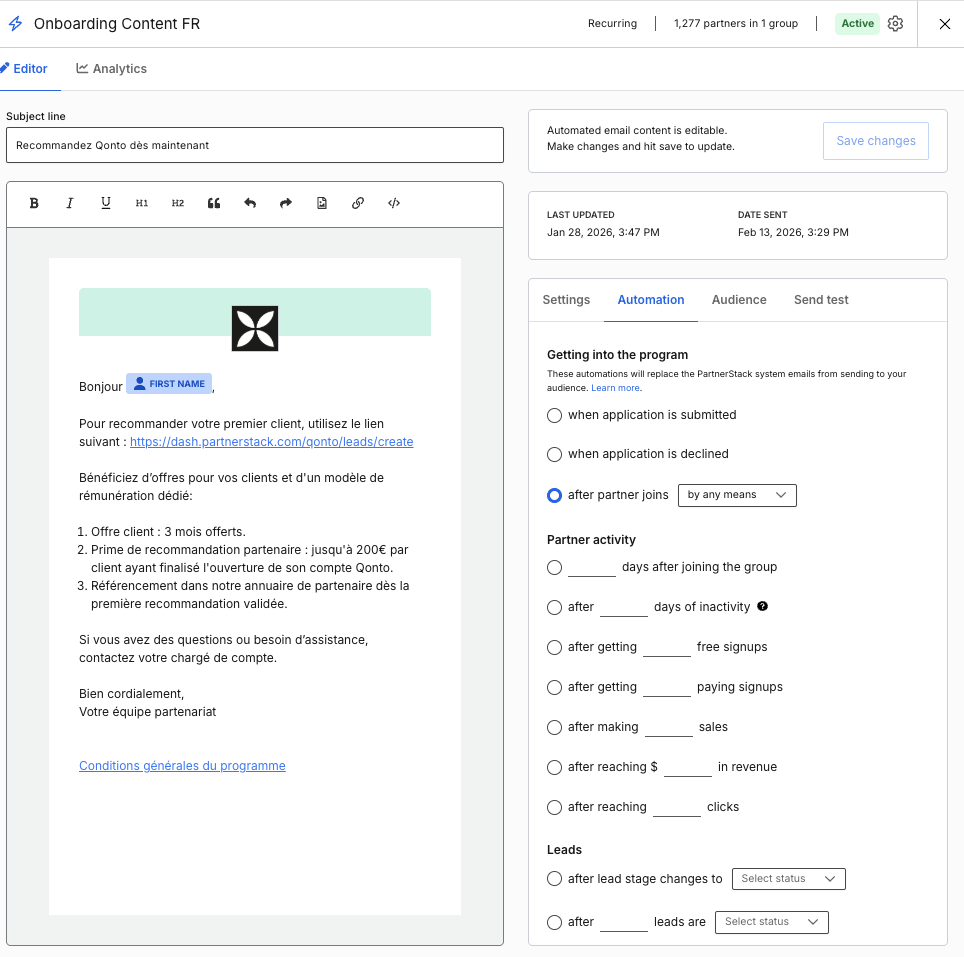
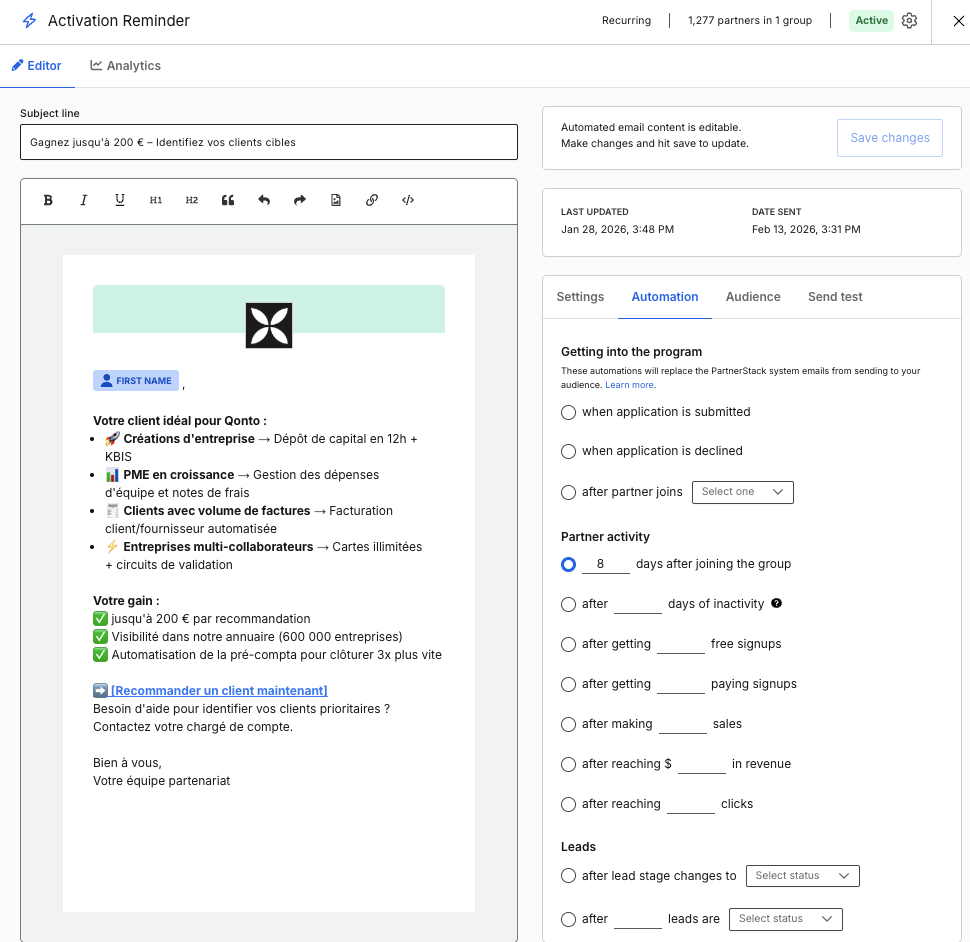
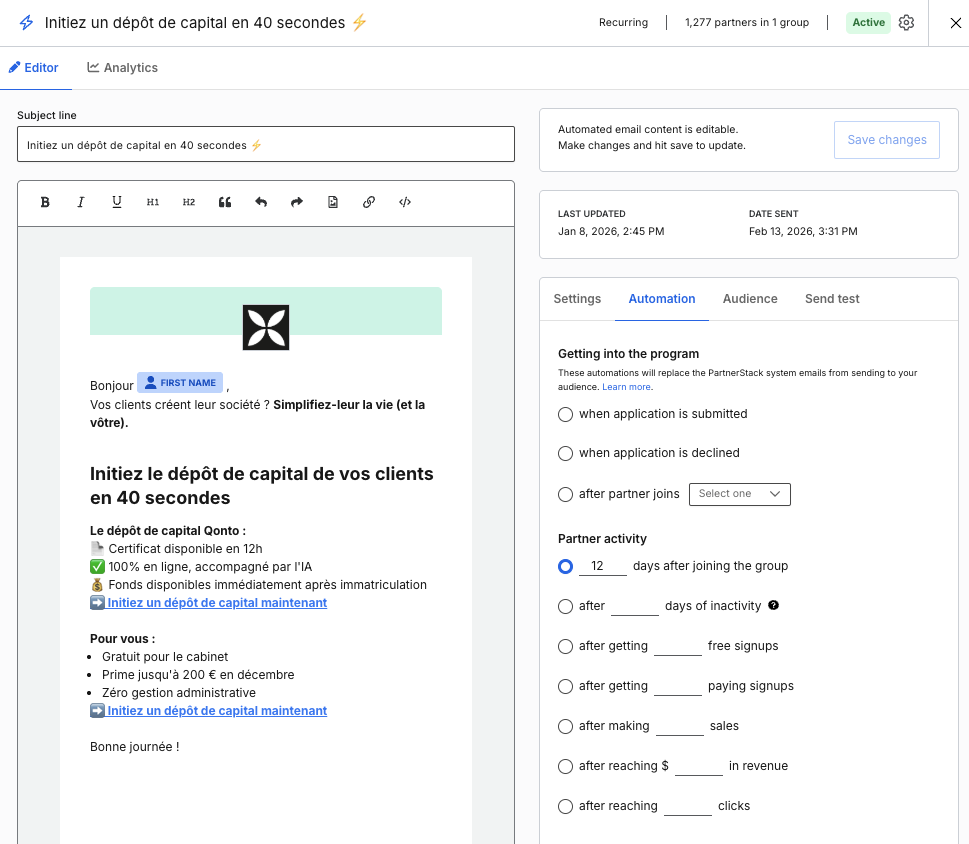
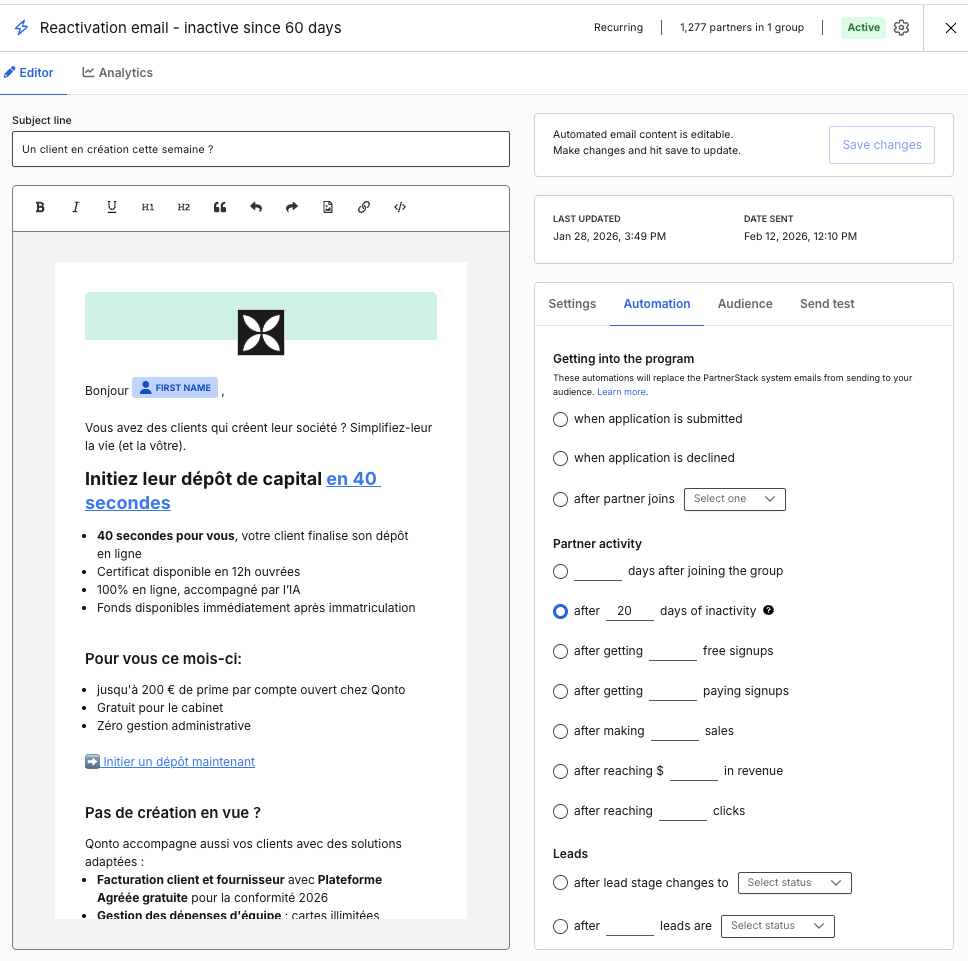
Partnerstack Automations (1,277 partners) | click to enlarge:
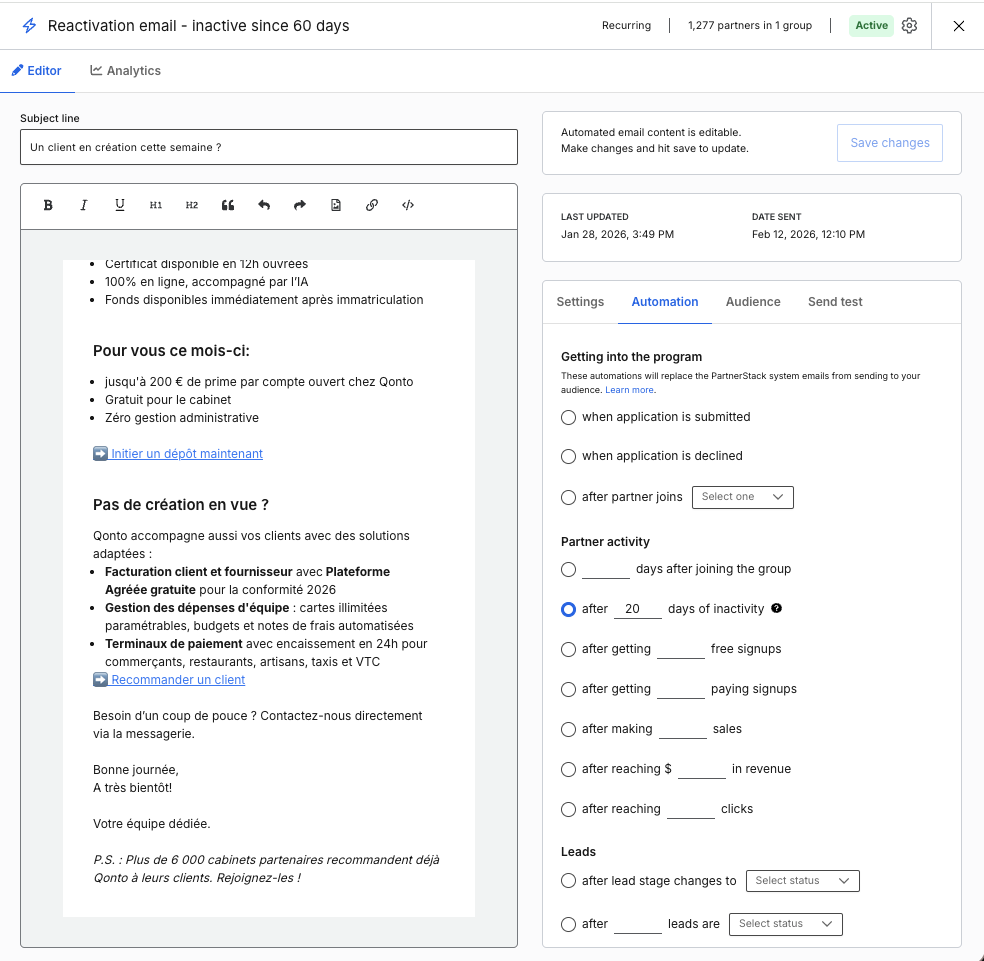
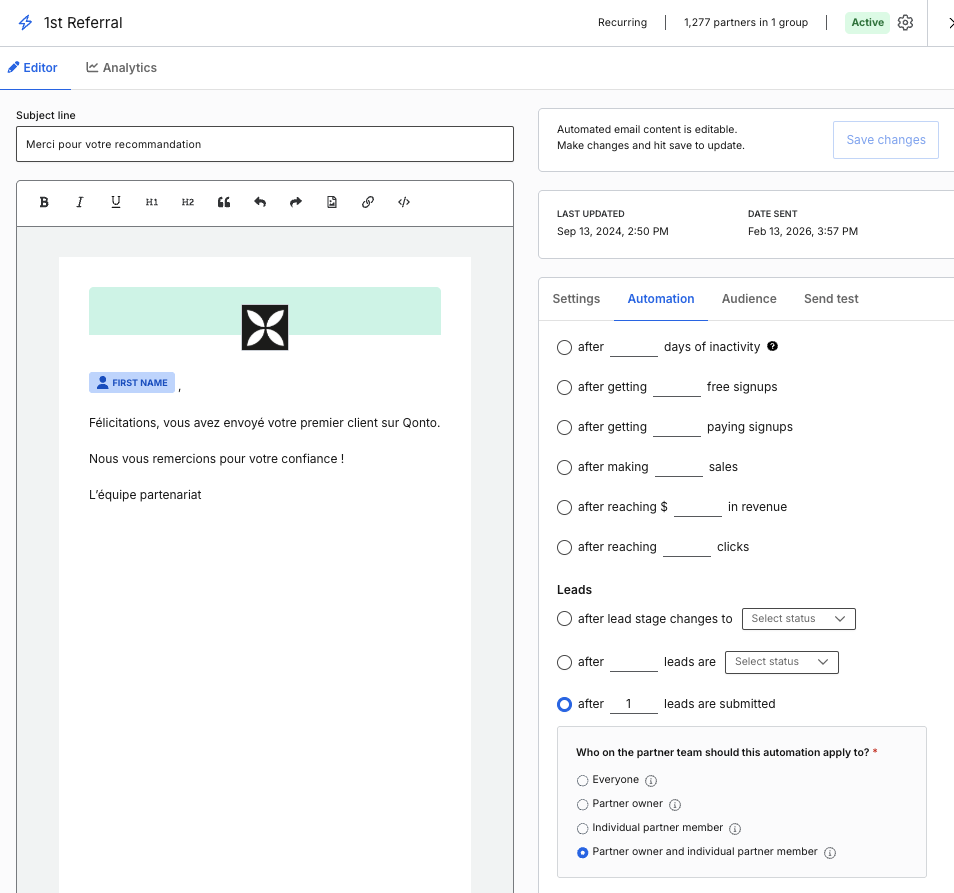
Customer.io automations (2 emails, fast-track):
- 1 email sent to the company creator and 1 email sent to the chartered accountant when the chartered accountant completes the fast-track for company creation/capital deposit (trigger: accountant completed the fast-track, tool: customer.io)
One-shots (example):
- Audience: 20K french accounting firms
- Content: invitation to join a Qonto Masterclass or to download a white paper
- Tool: HubSpot
Accountants team structure for France
SDR team
Audience: accounting firms registered on Qonto through the 'accountant role' which have never generated a KYB for Qonto
Responsibilities:
- Prospecting: Contact accounting firms (outbound calls, emails)
- Qualification: Assess if they match criteria (>50 capital deposits/year, location, portfolio size)
- Book meetings: Schedule discovery calls for AE's team with qualified prospects
AE team
Audiences: SQLs from SDRs + All accounting firms who already generated a KYB for Qonto ever
Responsibilities (CS = contract signed):
- Convert (0 → 1 KYB): Pitch the partnership offer, close partnerships (T&Cs signed via Leeway), onboard partners
- Develop & Activate (1 KYB → Recurring Revenue): Ensure partner sends ≥2 CS in first month, drive ≥6 CS in first 3 months, help partners understand who to refer and how
- Retain & Grow: Avoid churn/inactivity (58% dormant!), reactivate inactive partners
CSM & Training team
Audience: accounting firms as Product users of Regate by Qonto
Responsibilities: ensure accountants understand how to use tools effectively
Customer Service
Audience: accounting firms as Product users and SMEs onboarded on Regate by Qonto by the accounting firms
Responsibilities: operational/technical support for day-to-day issues
The Questions
Note: while Question A focuses on immediate priorities, Question B asks you to think more strategically about the long-term framework that would enable future growth.
Question A | Identify the "quick win"
The AE team lead lists the following priorities for you:
Priority 1: increase the activity of the existing base of 'active accounting firms'
- Ensure newly activated partners stay active until the end of M3 following the first KYB
- Increase the share of active accounting firms from 42% to 50%
- Improve the performance of 'recurring' accounting firms: increase the annual average KYBs/Active accounting firms for this segment from 7 to 7.5
Priority 2: grow the list of accounting firms which generated at least 1 KYB ever
- Accelerate the activation of accounting firms signed by the AE team
- Nurture the list of accounting firms which have access to Qonto ("accountant role") but have never generated a KYB for Qonto to identify better leads for the SDR team
Questions:
- Based on the information shared in the section 'Context' and on your experience, what do you think of this recommendation? Would you agree or reorder? Why?
- Would you like to get other information to challenge this list? If yes, please describe what you would need and why.
- For your chosen priority, what information would you need from the Accountants team and/or Product team to define what to implement?
Question B | Accountants lifecycle framework
The accountant channel presents a unique strategic challenge:
- Limited pool: Only ~20K accounting firms in France = a finite audience we cannot afford to mismanage.
- Multiple indirect entry points: accounting firms engage with Qonto in various ways (Partnership Program, "accountant role" access, Regate by Qonto users, Company Creation services), but our end goal is not to make them become clients, it's to make them influence their clients' decisions to use Qonto.
- Significant untapped potential: while about 10K accounting firms have a Qonto access ("accountant role"), only 1400 firms have generated at least 1 KYB.
Questions:
- Defining the end deliverable: What would an "accountant lifecycle framework" look like in your view? Describe:
- What key components or sections would it include?
- What types of information would it contain?
- What level of detail would be necessary to make it actionable for the team?
- Building the framework: How would you approach building this lifecycle framework? Outline:
- The critical "building blocks" that need to be defined along the way (e.g., segmentation, messaging, etc.)
- How you would collaborate with other teams throughout the process and what you would need from them
Context & Key Data
Accounting firms are a key acquisition lever for Qonto. The French market has ~20K firms covering 50% of freelancers and 80% of SMEs. The Growth team tracks 2 KPIs: # of KYBs and LTV from KYBs generated through accountant recommendations.
Accountant Funnel (France)
Activity Segments (2025)
| Segment | Avg KYBs / Active Firm | Definition |
|---|---|---|
| Recurring | 7.0 | KYB in 2025 AND 2024 |
| Activation (NEW) | 2.5 | First KYB in 2025 |
| Reactivation | 2.5 | KYB 2025 + before, NOT in 2024 |
KYB Sources (2025)
Entry Points
Accountants Partnership Program via Partnerstack. Commissions, directory listing, dedicated support.
Company Creation & Capital Deposit. Fast track: create in 20min, deposit in 40sec.
E invoicing compliance (Qonto PA). Reform September 2026 = massive opportunity.
Regate by Qonto. Automated pre-accounting, centralize all client docs.
Current Communications Stack
Identify the "Quick Win"
A.1 | My Recommended Prioritization
I mostly agree with the AE team lead's priorities, but I would reorder them. Here's my ranking with justification:
P2a: Accelerate post-signature activation
The data reveals a structural problem: 47% of KYBs are attributed manually by the AE team after the fact. There's a significant gap between signature and first KYB. The CAC is already spent; every day of delay means motivation decay. This is the "leaky bucket" principle: fix the hole before pouring more water.
CRM actions: Post-signature activation sequence, automate "manual" attribution through better tracking, reduce time-to-first-KYB with targeted nudges.
High impact | Fast to implement | Directly measurableP1a: Retain new partners through M3
Naturally follows P2a. Newly activated firms average only 2.5 KYBs/year, roughly 1 every 5 months. The onboarding sequence stops at J+12 and there's nothing until J+60. Between week 2 and month 2, partners are on their own.
CRM actions: "First 90 days" nurture sequence, milestone celebrations, AE alerts on risk signals.
High impact | Prevents churn at the most vulnerable stageP1b: Reactivate dormant base (42% → 50%)
Large pool of 800+ dormant firms. E invoicing reform (Sept 2026) creates a natural reactivation hook. Harder than maintaining active ones, but the volume opportunity is significant.
CRM actions: Segment dormant base by recency/entry point, targeted reactivation campaigns, re-engagement scoring for SDRs.
Medium High impact | Larger effort, big poolP2b: Nurture 8,600 "accountant role" firms
Largest untapped pool but most uncertain. These firms know Qonto as a product, not as a partnership channel. The SDR team already targets this audience; CRM should support them, not replace them.
CRM actions: Lead scoring model based on usage patterns, Partnership Program awareness campaigns, feed signals to SDR.
Medium impact | Strategic, longer time to valueP1c: Upsell recurring firms (7.0 → 7.5 KYBs)
Recurring segment already generates 65% of all KYBs. Going from 7.0 to 7.5 is a +7% uplift on a segment already working well. CRM alone may not be the right lever; these firms need deeper AE relationship management or commercial incentives.
CRM actions: Learn from top decile behavior, cross-sell new entry points, seasonal campaigns.
Low to Medium impact | Incremental gains on optimized segmentA.2 | Data Gaps: What I'd Need to Challenge This List
To make the prioritization truly data-driven (and not just intuition-based), here's what I'd want:
1 Churn curve by cohort
For each monthly cohort of newly activated firms, what does the activity curve look like over 12 months? At what point do most firms go dormant?
If most churn happens in month 2 to 3, P1a becomes even more critical. If it happens after month 6, the problem is different (value proposition decay, not onboarding failure).
2 Breakdown of the 47% "manual" attribution
How are these KYBs actually happening? Are firms actively referring but not using tracking links? Or are AEs retroactively claiming existing Qonto clients?
If it's a UX/tracking problem, it's an easy CRM fix. If AEs are retroactively claiming clients, the actual organic referral rate is much lower than reported.
3 LTV by KYB source and segment
What's the average LTV of a client referred through each source channel? Do "lead" KYBs have higher-LTV than "manual" ones?
If recurring firms generate higher-LTV clients, P1c might deserve a higher rank despite smaller volume potential. Revenue matters, not just count.
4 Time to first KYB distribution
From partnership signature to first KYB: what's the median? The P90?
If median is 3 weeks, the current onboarding sequence ending at J+12 is clearly insufficient. If it's 3 months, we need a different approach.
5 AE team conversion rate & pipeline
How many firms signed per month? What's the conversion rate from signed to first KYB?
P2a assumes a meaningful volume of signed but not activated firms. If 50 sign and 48 activate, the problem is elsewhere.
6 Usage patterns of 8,600 dormant firms
Are these firms actively using the accountant role features? Or invited once and never logged in?
Active product users who aren't referring = warm leads (P2b goes up). Completely inactive = much longer conversion path.
A.3 | Information Needed from Teams
For my top priority (P2a | Accelerate post-signature activation):
From the Accountants Team (AE + SDR)
1. AE Pipeline & Workflow
- How many new partnerships are signed per month?
- What does the current onboarding handoff look like? (AE signs → then what?)
- Is there a structured "first 30 days" playbook for new partners?
- What triggers exist for AE follow-up after signature?
Why: Without pipeline data, I can't size the activation gap or design the right sequence cadence. If AEs sign 50 firms/month but only 30 activate, that's a 40% drop-off to target.
2. AE Qualitative Feedback
- Top 3 reasons new partners don't generate their first KYB quickly?
- What objections or blockers during onboarding calls?
- Which partners activate fastest, and what do they have in common?
Why: Quantitative data tells me what happens, qualitative tells me why. The top blockers directly inform the messaging and trigger logic of the activation sequence.
3. Current Event Tracking
- What partner events are tracked in Partnerstack? (login, link generation, downloads)
- What CRM data is available in Customer.io?
- Any partner activity data that exists but isn't piped into CRM tools?
Why: I can only automate what's tracked. If Partnerstack doesn't fire events on referral link generation, I can't build behavioral triggers, and the sequence becomes time-based only.
From the Product Team
4. Espace Qontable Roadmap
- Timeline for the unified Accountant Hub?
- Features at launch? Event tracking/analytics built in?
- How will existing Partnerstack flows migrate?
Why: If the Hub launches in 3 months, I need to build flows that are compatible or migration-ready. Building in Partnerstack today only to rebuild in Espace Qontable tomorrow would waste time.
5. "Accountant Role" Product Analytics
- What actions do accountants perform after login? (frequency, features used)
- Can we track when an accountant views a client not yet on Qonto?
- Any intent signal data we can leverage?
Why: Product usage data is the strongest intent signal we have. An accountant who logs in 3x/week and exports documents is far more likely to refer clients than one who logged in once.
6. Email Capabilities per Tool
- Sending limits of Partnerstack vs. Customer.io vs. HubSpot?
- Plan to consolidate onto one tool? Which one?
- Personalization tokens available in each?
Why: The activation sequence is only as good as the tool it runs on. If Partnerstack can't do branching logic or behavioral triggers, I need to build in Customer.io, which means data piping.
Accountants Lifecycle Framework
B.1 | What Would the Framework Look Like?
The accountant lifecycle framework is the single source of truth that maps every accounting firm's journey with Qonto. It serves three audiences: the CRM team (automate the right message at the right time), the AE/SDR teams (know who to call and why), and leadership (track pipeline health and forecast).
I'd design it as a matrix with 6 lifecycle stages cross-referenced with 3 layers of information.
Important disclaimer
The 6 stages below are illustrative; they represent my initial thinking based on the business case data alone. Nothing is fixed. The actual lifecycle framework will be shaped by data discovery (Phase 1), team input, and the realities I'll uncover during the mission. The number of stages, their definitions, and transition criteria will all evolve through collaboration with the Accountants team, Product team, and CRM leadership.
The 6 Lifecycle Stages
| Stage | Entry Criteria | Exit Criteria |
|---|---|---|
| Unknown | Part of the 20K French firms universe | First identifiable touchpoint with Qonto |
| Aware | Attended webinar, downloaded whitepaper, visited landing page | Joins Program OR gets "accountant role" OR signs up for Regate |
| Signed | Partnership registration, "accountant role" granted, Regate onboarding | First KYB generated |
| Activated | First KYB attributed (any source) | 2+ KYBs AND active for 3+ consecutive months |
| Recurring | Active current year AND previous year, 2+ KYBs trailing 12mo | 6+ months without KYB → "At Risk" sub-state |
| Advocate | 7+ KYBs/year OR case studies/events OR refers other firms | N/A (aspiration stage) |
Layer 1: Segmentation & Scoring
Every firm gets scored on two dimensions: Engagement (behavioral: product usage, email interactions, logins, referral link generation) and Potential (firmographic: portfolio size, specialization, geography, company creations/year).
Segmentation also considers entry point motivation:
Layer 2: Communication Playbook
For each stage: Goal, Key messages, Channels, Triggers, Sequences, Handoff rules, Content assets.
Example: Signed → Activated Transition
- Goal: First KYB within 30 days
- Key messages: "Refer your first client in 3 clicks" + social proof from similar firms
- Channels: Email (Customer.io) + AE call at day 14 if no activity
- Triggers: Day 1 post-signature, Day 3 no login, Day 7 no referral link, Day 14 no KYB
- Sequence: Welcome → How-to guide → Success story → AE outreach
- Handoff: If no KYB by Day 21, AE gets an alert in CRM
Layer 3: KPIs & Measurement
| Stage Transition | Primary KPI | Secondary KPIs |
|---|---|---|
| Unknown → Aware | MQLs | Webinar attendance, whitepaper downloads, LP conversion |
| Aware → Signed | Sign up rate by entry point | Time first touch to sign-up, channel attribution |
| Signed → Activated | Time to first KYB, activation 30/60/90d | Referral link generation rate, Partnerstack login freq |
| Activated → Recurring | Retention rate M6/M12 | Engagement score trend, multi-entry adoption |
| Recurring → Advocate | KYBs/year, LTV of referrals | NPS, event participation, case study willingness |
| At Risk (regression) | Reactivation rate | Drop off trigger identification, win-back conversion |
Making It Actionable
The framework should be a living document hosted on whichever documentation tool is already in Qonto's stack, editable by all stakeholders (CRM, AE, SDR, Product) so it stays current and reflects ground-level reality. It would include:
- Visual lifecycle map | single page view, all stages, volumes (updated monthly)
- Stage level detail pages | full playbook per stage
- CRM implementation spec | trigger logic, audience filters, templates, tool
- Data requirements doc | events/attributes to track, sources, transformations
The framework is NOT a strategy deck. It's a working reference that the AE team checks before calling, that the CRM tool executes against, and that leadership reviews monthly.
B.2 | How Would I Build This Framework?
Data Audit & Landscape
Objective: Understand what we have, what we're missing, and where the bodies are buried.
Building blocks:
- Data inventory: Map every data source (Partnerstack, Customer.io, HubSpot, Leeway, Regate, data warehouse). Events tracked, attributes, quality, update frequency.
- Current-state journey mapping: Document the actual experience of an accounting firm today across all entry points. Every email, AE touchpoint, product interaction.
- Cohort analysis: Build the churn curve, identify "aha moments" that correlate with retention, quantify drop-off at each stage.
Access raw data, help build cohort analysis, validate quality
2 to 3 shadowing sessions, understand daily workflow & CRM usage
Event tracking docs for Espace Qontable, accountant role, Regate
Data Audit Report: map, gaps, journey map, cohort analysis, recommendations
Framework Design & Mapping
Objective: Design the lifecycle stages, segmentation model, and scoring system.
Building blocks:
- Lifecycle stage definitions with precise entry/exit criteria based on available data
- Segmentation model: engagement + potential scoring dimensions, signals, thresholds
- Transition triggers: what events trigger CRM action vs. AE action
- Communication strategy per stage: messages, channels, cadence, content needs
Co-design handoff rules. Their buy-in is critical.
Messaging pillars, content assets, campaign calendar
Validate product events as triggers, discuss in-app messaging
Lifecycle Framework v1: map, stages, scoring, playbook, KPIs, gaps
Build & Implement
Objective: Translate the framework into live CRM campaigns, starting with highest-impact transitions.
Building blocks:
- Priority #1: Start with Signed → Activated sequence (P2a)
- Sequence design: trigger conditions, wait steps, branching logic, email templates, AE alerts
- Tool selection per sequence (minimize fragmentation)
- A/B testing plan for subject lines, timing, content
- Reporting setup: stage-level KPI dashboard from day 1
Email copy, landing pages, case studies
Build data pipelines feeding scoring model into CRM
Training on new signals/alerts, feedback loop
Live campaigns + monitoring dashboard + sequence backlog
Cross-Team Collaboration Model
30min. Review CRM-generated leads, feedback, scoring adjustments.
30min. Espace Qontable timeline, event tracking, in-app opportunities.
1h. Full funnel review, conversion rates, anomalies, next priorities.
All framework docs, sequence specs, performance reports in one shared space (adapting to Qonto's existing tooling).
How I'd communicate with my direct team
Async-first, with regular checkpoints
- Shared workspace (using whatever doc tool is already in the stack): All framework docs, sequence specs, performance dashboards, and meeting notes live in one place. This is the single source of truth; anyone can check progress, leave comments, or flag issues without scheduling a meeting.
- Weekly 1:1 with Coralie/Chloe (30min): Progress update, blockers, upcoming decisions. Short, structured agenda shared beforehand.
- Team messaging channel (Slack, Teams, or whichever tool the team uses): For quick questions, sharing wins (first KYB from a new sequence!), and flagging anomalies in real-time.
- Written updates: Daily (or twice daily), a concise written summary of what was done, what was learned, and what's next. At the end of each phase, a more detailed recap. This keeps leadership informed without requiring sync time.